


Combustible cladding material ignited during remediation work
- Cladding Concerns
-

By Gerry Sharpe
- Aug 26, 2024
Combustible insulation on a high-rise residential building caught fire recently during cladding remediation work, it has emerged.
A worrying report
The report said that unsafe working practices would appear to be the underlying cause of the near miss.An anonymised report submitted to the independent safety body Collaborative Reporting for Safer Structures UK (CROSS-UK) suggests that unsafe working practices are likely to be behind this case.
The incident was discovered by a CROSS reporter during a recent visit to a residential high-rise cladding remediation project.
According to CROSS-UK, the reporter “identified a render-faced wall with an expanded polystyrene (EPS) core attached to the building’s structure. Damage was noticed to the insulation from apparent combustion within the EPS element.
“Friction from powered cutting tools was indicated as the cause of localised ignition within the external wall. The combustion appears to have been extinguished after a short time in this instance but was not reported or identified as having occurred to the team on site.”
The account also noted that “there does not appear to have been an extinguishing medium used, and therefore this has been identified as a near miss to the contractor, design team, and client. There is the potential that the fire could have entered the cladding and proceeded to burn extensively within the cavity between the cladding and the structure."
“It is the principal contractor’s responsibility to ensure fire prevention measures are in place during remediation works. A suitable and sufficient fire risk assessment should be undertaken by a competent person concerning the proposed works on site,” the report continued.
“ According to the reporter, there was a complete disregard for the requirement under the CDM Regulations to ensure that the proposed works do not compromise the safety of construction operatives. ”
Probe launched
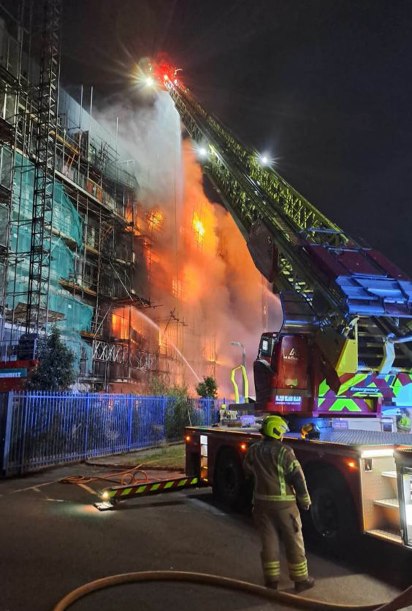
The London Fire Brigade (LFB) will start “a full investigation” into the causes of a huge fire that ripped through a block of flats in Dagenham, east London, in the early hours of Monday (26 August 2024).
The whole of the building was affected by the fire, including the scaffolding surrounding the property and the roof being used for the remedial works.
Everyone was accounted for during the evacuation.
London Fire Brigade commissioner Andy Roe said the building had safety issues known to the LFB, which will begin a full investigation into the fire and its cause.
Roe said: “We were called to the incident at 02:44 [on Monday]. The first crew arrived within five minutes and the second crew arrived within six minutes. An aerial appliance also arrived in under six minutes. To allow us to focus our resources on the incident, we declared a major incident, which has now been stood down.
“The building has a number of fire safety issues known to London Fire Brigade. A full simultaneous evacuation of the building was immediately carried out and a significant search and rescue operation took place.
“We will now begin a full investigation into the fire and its cause. This was a very dynamic and challenging incident, and we know there will undoubtedly be concerns around the fire safety issues present within the building and this will form part of our report.”
Only a third (29%) of residential buildings with unsafe cladding in England have completed remediation
The monthly data from the Ministry of Housing, Communities and Local Government (MHCLG) shows that, as of the end of July, just 2,299 (50%) of the 4,630 residential buildings 11m and over in height identified with unsafe cladding have either started or completed remediation works.
The MHCLG statistics also show that of the 499 high-rise (18m and over in height) residential and publicly owned buildings with aluminium composite material (ACM) cladding systems, 488 (98%) had either started or completed remediation works, an increase of one since the end of June.
- Lack of Qualified Contractors.
- Too long timeframe before removal and replacement.
- Poor Working Practices.
- Lack of Heath & Safety.
- Variations away from the approved design.
Of these, 438 buildings (88%) had completed ACM remediation, including those awaiting Building Control sign-off, an increase of one since the end of June 2024.
There are 11 buildings yet to start ACM remediation (2% of all buildings), a figure that hasn’t changed since the previous dataset was released. One building is vacant, seven occupied buildings have forecast start dates, two further buildings have had local authority enforcement action taken against them, and the remaining buildings came into scope in April 2024, when the Building Safety Act regime transition ended.
The Phase 1 report of the Grenfell Tower Inquiry found that ACM cladding panels had been the “primary cause” of the rapid spread of the fire in the Grenfell Tower on 14 June 2017. A total of 72 people were killed and the high-rise destroyed in one of the worst disasters in post-war Britain.
Gerry Sharpe, FACQP
Setting standards above compliance - Always - No one has ever won a contract by saying we're going to work to the bare minimum on Quality!
Email us to add your News
Email the News Team